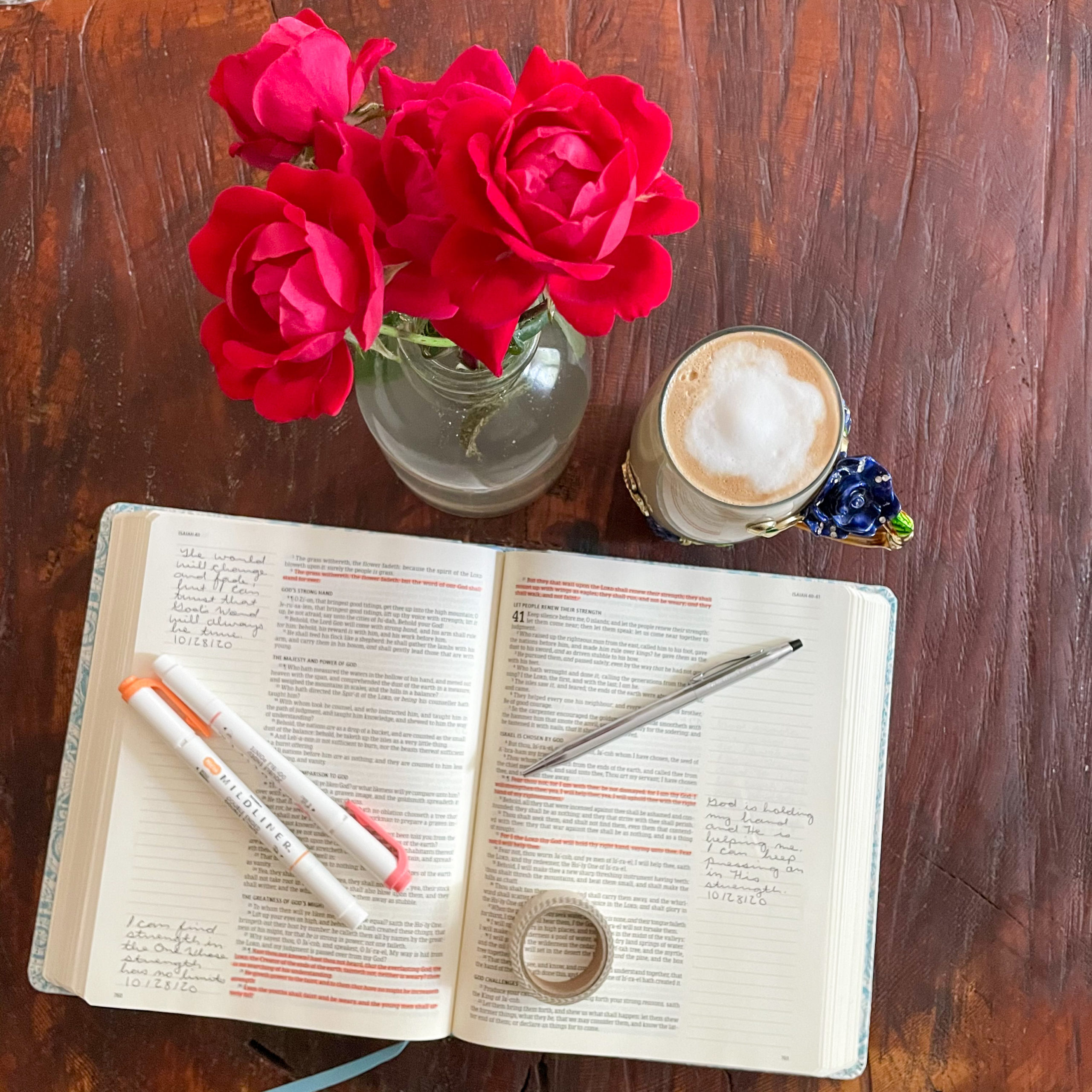
Journaling is by far my favorite activity. I started keeping a journal when I was ten years old, and I’ve hardly missed a day since. I saw a journaling Bible for the first time when I was in high school, and the concept was beyond appealing to me. I don’t know why it took me so long to actually get one. Probably because I’ve never actually bought myself a Bible; they’ve always been gifted to me.

My husband bought a journaling Bible for me last fall. A friend of ours hand painted the cover, and it is absolutely beautiful. Beauty aside, what I love about it the most is the purpose for which it was made: taking notes in the margins. I’ve always written notes in the tiny margins of my Bibles, but I finally have a Bible with plenty of space for writing. If you’re interested in Bible journaling, I want to share my Bible journaling essentials with you to help you get started.

A JOURNALING BIBLE

This one is obvious, but you’ll need a journaling Bible. There are many options, and it can be easy to get overwhelmed. The two main options are margins without lines and margins with lines. My journaling Bible has margins with lines. This is a good option for me because I’m using it to write notes about the passage of Scripture I’m reading. If you’re a note taker, this would be a good option for you. I like this one.

If you’re more artistic and want to do hand lettering or sketches in the margins, a Bible without lined margins might be a better option for you. This one would be perfect!

HIGHLIGHTERS

I was never one to highlight in my Bible until I started using a journaling Bible, but now that I’ve started, I don’t think I’ll ever go back. Underlining is fine, but highlighters look so much neater. I love these highlighters because they are double ended. The fine tip end is perfect for highlighting in smaller print Bibles. They’re also not fluorescent like most highlighters, and they don’t bleed through. (Disclaimer: journaling Bibles usually have thicker pages. I can’t say if they would bleed through a regular Bible with very thin pages.)

A PEN

You’ll want a pen that you like to write with. I use a nice ballpoint pen like this one. Fountain pens are always fun, but I haven’t tried one in my journaling Bible. This really depends on your preference. If there’s a type of pen you normally like writing with, go with that one. You really can’t go wrong.

WASHI TAPE

You can use washi tape for so many different things. The thing I use it for the most is marking the verse where I left off. I just tear off a little piece and stick it by the verse where I want to pick up tomorrow. It won’t ruin the pages of any Bible, and you can reuse the same piece over and over. You could also stick a strip of washi tape vertically beside a passage you want to take notes on. This would mark which verses go with which notes. Get creative here!


The sky is really the limit when it comes to Bible journaling, but these are my essentials to get you started. If you have any other tips, I would love to hear about them in the comments!
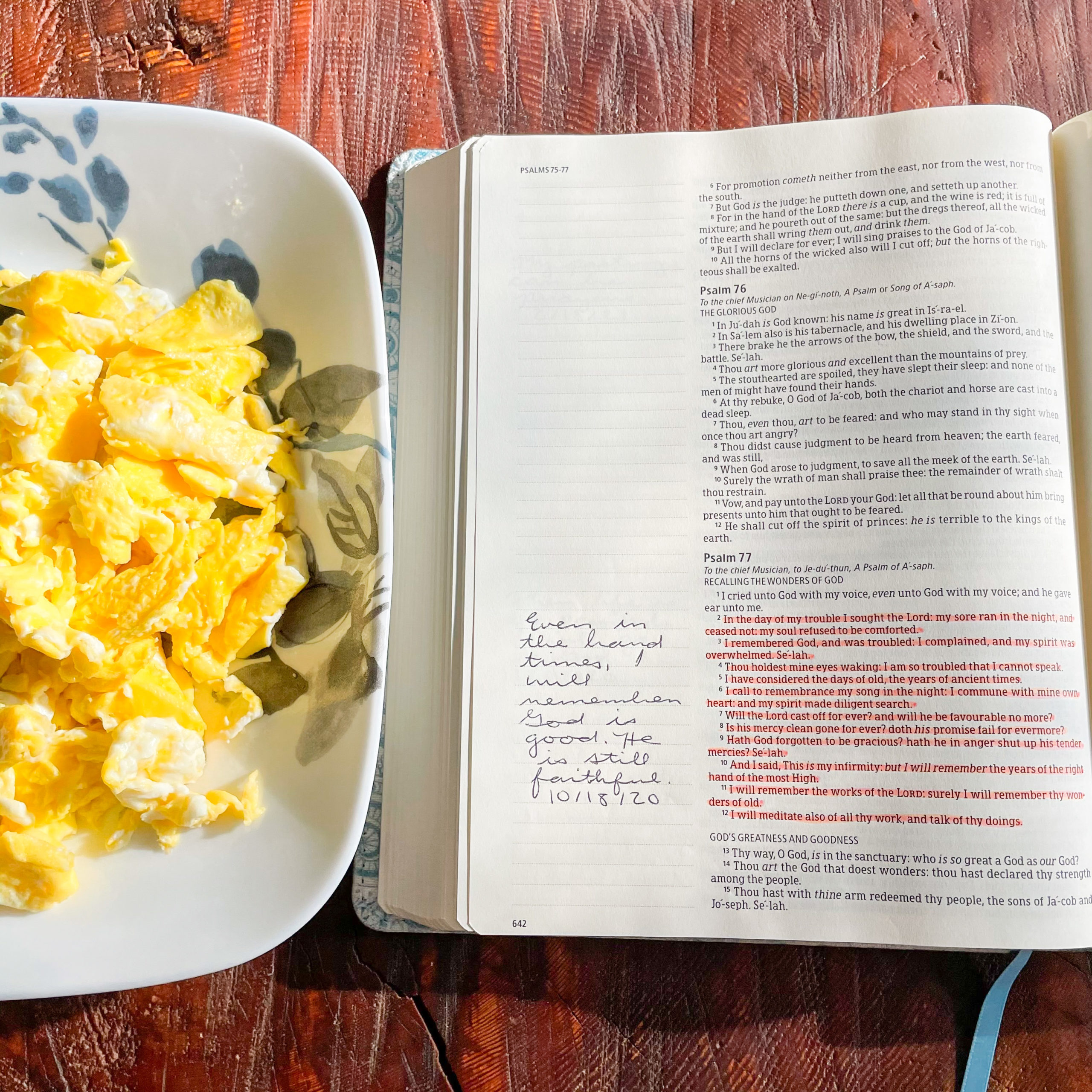
 

My toddler woke up at 6:45 a.m. this morning ready to go. Ready or not, it was time to get up. I don’t even try to get up before my little early riser to read my Bible in the morning, and I’m totally okay with that. There’s nothing wrong with waiting to have a quiet time when you’re at your best. For me right now, that’s 1:30 p.m. when my toddler is napping. That’s my daily appointment with the Lord, and I look forward to it.

I’ve heard many good arguments for keeping a morning quiet time, and I have no desire to dispute those. There are excellent reasons to meet with the Lord first thing in the morning, and I look forward to the time when I will again be able to have that time in the morning. Meeting with the Lord in the morning sets the tone for your day and gives you the strength you need for whatever may come your way. But if it’s not possible to have a quality quiet time with the Lord in the morning, there are a few things you can do to set the right tone for your day anyway.

READ A FEW VERSES TO START YOUR DAY

Our Bible reading time doesn’t always have to be extensive, and our quiet time may not always be quiet. Even though I don’t have my quiet time in the mornings, I like to read a Psalm out loud at the breakfast table with my daughter. It’s important for her to hear the Word of God, but I do this mostly for myself. This gives me a chance to get my focus on the Lord, and it sets a positive tone for the rest of my day.

LISTEN TO AN AUDIO BIBLE

If you’re an auditory learner like my husband, this may be a good option for you. You can listen to the Bible on an app on your phone while you get ready in the morning. I still recommend having a time later when you sit down and focus completely on spending time with God, but this is a great way to set the tone for your day until you have time for a more focused quiet time.

PLAY UPLIFTING MUSIC

Even when life is a little chaotic, having uplifting music playing in the background can make a big difference in your mindset. Have a go-to playlist of encouraging Christian music to easily set the right tone for the day for your entire family. When things quiet down a little bit and you are able to have a focused time with the Lord, your heart will already be prepared for what He has to teach you.

I pray that these ideas will give you a practical way to set the tone for your day when it’s just not possible to have a morning quiet time. Do you have any more tips? Tell me about them in the comments! If you need a practical way to focus your attention on the Lord, I have a free resource just for you. The 60 Second Quiet Time is designed to teach busy women how to take just one minute to refocus their attention on the Lord. Enter your name and email address below, and I will send this guide directly to your inbox!


I’ve consistently taken sermon notes for over half of my life, but I’ve always felt a little bit of regret that I didn’t know how I could possibly find a set of notes again if I wanted to reference it. So, my journals have just collected dust on my shelves as time has passed. Occasionally I’ve remembered a specific sermon and tried in vain to find my notes. I may have actually gone back and read my notes once or twice, but certainly no more than that.

I was recently sitting listening to a sermon, and there were so many incredible truths mentioned that I wanted to write all of them in the margin of my Bible so that I wouldn’t forget them! Unfortunately, there wasn’t room in the margin of my Bible, and I was faced with the sad reality that I likely wouldn’t go back and read my sermon notes again. In that moment, I thought of a way that I could easily reference my sermon notes over and over again. Not only would this serve to help me remember the sermons I hear, but it would also enhance my personal Bible study. Over the last couple months, I’ve developed a system to take sermon notes that are actually usable. I hope part (or all!) of this system will be helpful for you, too.

Keep your notes in one place, in chronological order.

Whether you scribble sermon notes on the back of a bulletin or fill in the blanks on a handout, chances are you aren’t keeping that piece of paper very long. I love fill in the blank handouts as much as the next person, but after a while, it’s almost impossible to keep up with them all!

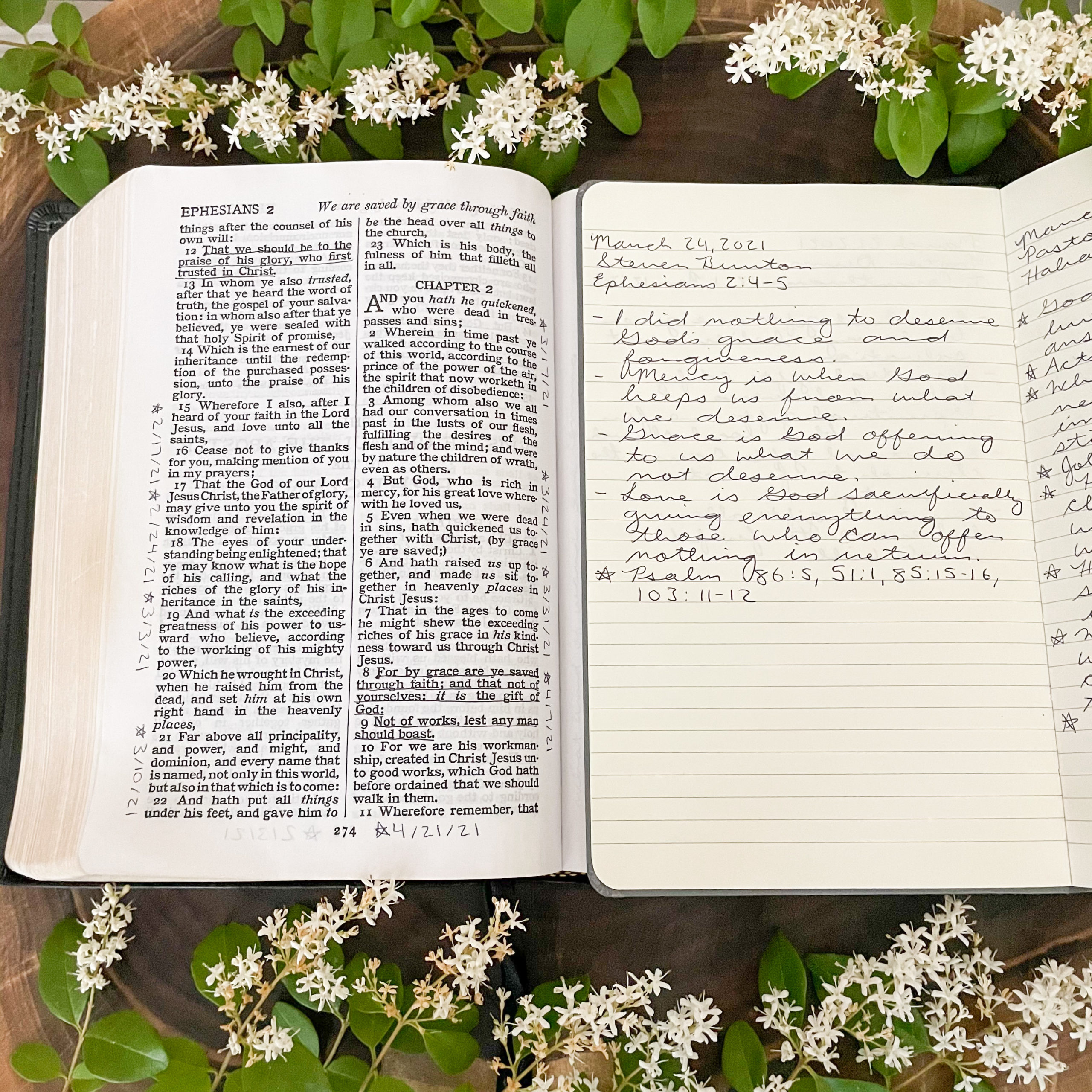
Personally, I find that it’s best to have a notebook specifically for taking sermon notes. I use these Moleskine notebooks. If your church does use some sort of printed outline, go ahead and take one; just transfer any notes you want to keep into your notebook.

If the fill in the blank outline is a must for you, there are a couple ways to keep them organized. You could keep them all in a file box in chronological order, but this may be a little more difficult to sort through when you need to find a specific set of notes. The second option is a bit more labor intensive, but if you have a scanner, you can scan the handouts and save them in a file together on your computer. I had hundreds of sermon notes handouts from college, and I still have them saved on my computer this way.

Whether you write your notes in a notebook, keep them in a file, scan handouts into your computer, or do something entirely different, make sure you keep them in chronological order.

Write the date at the top of your notes and in your Bible next to the key passage.

This is the key to being able to find your notes when you need them. If you’re looking for notes on a specific passage or topic, you’ll be able to find the date in the margin of your Bible. If you have your notes in chronological order, it will be easy to find any notes you have on that specific passage.

I only recently started doing this, but I know it will be so helpful in making my sermon notes actually useful! I’ve kept notes in chronological order for quite some time, so I plan to go back and write the dates for the notes next to the key passages in my Bible.

I realize some people don’t like to write in their Bibles, but I would really encourage you to try this. God wants His Word to make a difference in our everyday lives, and if writing a date in the margins can help you, you should do it! I have a few Bibles (as do many Americans; we are so blessed!), and I use one exclusively for church. There are a few notes in the margins of this Bible, but it’s mostly open for writing dates. If it would help you to get a new Bible just for this purpose, go ahead and do it! It doesn’t have to be anything fancy or expensive, and the margins don’t have to be especially wide. You just need to be able to write a date. Something like this would work just fine.

Take lots of notes, including lots of Scripture references.

If you don’t know where to start with taking notes, you can just write down the main points as the preacher gives them. Sometimes I do this, but sometimes I just write down the statements that especially speak to my heart. No matter how you take notes, I would encourage you to write down as many Scripture references as you can that are mentioned in the sermon. When you go back to study a passage later, you will be able to look up the references related to that passage. And who knows? Maybe you’ll have sermon notes on those passages to take your study even further!

I hope something here will be helpful to you! Do you have any other ways you keep your sermon notes organized and usable? Let me know in the comments!


I mentioned in a recent blog post, How to Read Your Bible More, that we need to drop the guilt about our quiet time. Bible study is not a competition, and it’s not a race. Nonetheless, sometimes we find that we feel guilty over some perceived shortcoming in our Bible study time. I’m very consistent with my quiet time now, and more and more I’m setting aside the guilt that comes so naturally when my time with God doesn’t look exactly like I think it should. But this wasn’t always the case.

I can’t help but thinking back to a warm spring night when I was sixteen. My family had gone to a baseball game that evening, and we got home very late. I had been pretty consistent with having daily devotions for a few years, but I missed days here and there. As I laid in bed that night, I realized I hadn’t opened my Bible all day long. The guilt struck, and I promised myself that I would never let it happen again.

That promise carried me for quite some time in my journey to know God. Although it helped me to get into a good habit, my motivation was anything but good. I didn’t want to feel guilty! Over time, my motivation has changed, and I’m far more concerned with having a relationship with God than I am with how many days I read my Bible this week. I hope you don’t struggle with guilt over missed days of quiet time, but if you do, I want to give you three practical tips to help you drop the guilt.

STOP COMPARING

One pitfall we often find ourselves in is comparing what we do to what others are doing. But the Bible itself tells us that this isn’t wise.

2 Corinthians 10:12

For we dare not make ourselves of the number, or compare ourselves with some that commend themselves: but they measuring themselves by themselves, and comparing themselves among themselves, are not wise.

We see that mom who wakes up before the sun rises to have a quiet Bible study time first thing in the morning, or that retired lady who seems to have all the time in the world to study God’s Word if she wants. Meanwhile, we have to sneak in a few minutes of time with God in the car before a long shift at work, or we desperately grab for a verse to hold onto as little feet are padding down the hallway way too early.

And then the guilt sets in.

“If I just had the discipline of that person, I would have gotten up earlier.”

“If I just had the time that lady has, I would be able to read my Bible more.”

If we want to make progress in our walk with God, this kind of thinking has to stop. The truth is, God knows exactly how much time we have, and He knows the limitations we face. Rather than comparing ourselves with others, He simply wants us to give Him the time we do have.

And it may help to remember that the mom that seems like she has it all together and the retired lady with “all the time in the world” have their own limitations too. Life happens to them just like it happens to you, and their quiet time gets cut short. Maybe they feel the same guilt. Rather than drowning in guilt, let’s find safety in the boat of God’s grace.

RECEIVE GRACE

When you realize just how much grace and compassion the God of the Bible has for you, it becomes much more difficult to feel guilty over a quiet time that doesn’t look exactly like you thought it should. God doesn’t have a sticker chart in heaven where He marks how many days you’ve had a devotion time, and He’s not standing over you with a stop watch to see how much time you spend. He’s eagerly awaiting every second you spend with Him each day. And even if some days that looks like spending one minute in His Word, He’s ready to reveal Himself to you in that time.

And if you miss a day? God is there to give grace for that as well. Ideally, we would spend time with God every day because we love Him so much. But when life gets in the way, and interruptions keep demanding your attention, God knows all about it. He understands. He’s not standing there waiting for you to fail to spend time with Him so that He can punish you; He’s ready to show mercy to your weary soul.

Lamentations 3:22-23

It is of the LORD’S mercies that we are not consumed, because his compassions fail not. They are new every morning: great is thy faithfulness.

God knows exactly what you’re going through. Rest easy in his grace, and arise the next morning knowing that His compassions fail not.

LOOK AHEAD

Looking back and wishing you had spent more time with the Lord is rarely helpful. You can’t go back and change the past, but you can determine in your heart to rearrange your priorities in the future to spend more time with the Lord. 

Philippians 3:13-14

Brethren, I count not myself to have apprehended: but this one thing I do, forgetting those things which are behind, and reaching forth unto those things which are before, I press toward the mark for the prize of the high calling of God in Christ Jesus.

What are you spending your time on that you could possibly set aside to be able to spend more time with God? Is it your phone? A favorite TV show? Reading? None of these things are bad in and of themselves, but when they take priority over God’s Word, you would do well to evaluate how you could better spend your time.

As you spend more and more time with God in His Word, you will begin to anticipate with excitement that time with the Lord. There’s no need for guilt when we serve a God of grace.

If you want more help having a daily quiet time with God, sign up below to get The 60 Second Quiet Time guide sent to your inbox for free. It’s so important to start small when we’re trying to establish a new routine. This guide will help you to start having a consistent daily quiet time. It provides a practical tool for you to use when it seems like you just don’t have time in your day for a pause. No time spent with God is wasted; He wants to change your life. Will you let Him?